
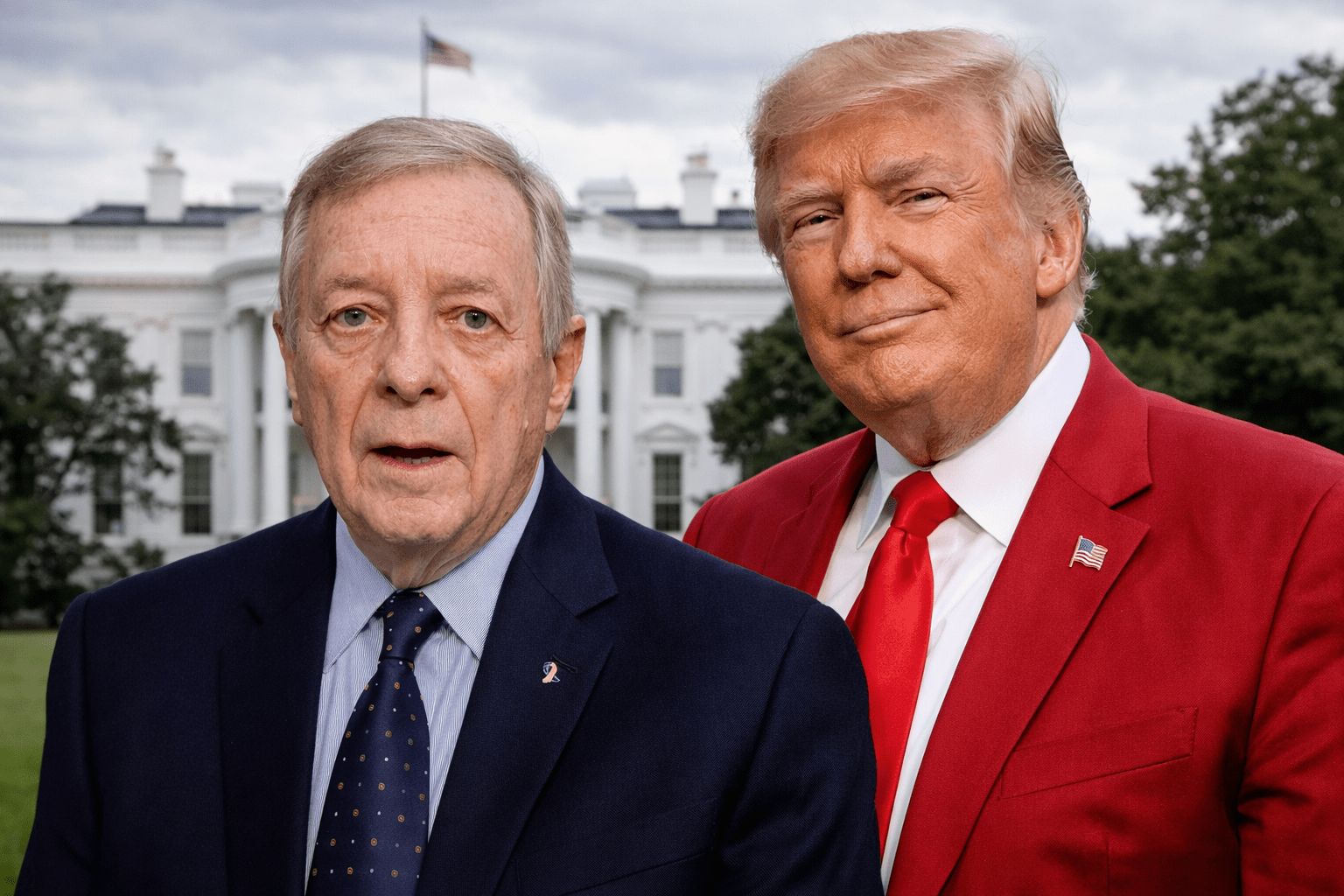
The tension was unmistakable from the moment Senator Dick Durbin rose to speak on the Senate floor on February 11, 2026. In a speech that quickly drew national attention, the Senate Democratic Whip delivered a sweeping and forceful critique of President Donald Trump and his administration, accusing them of attempting to reshape the very foundations of American democracy. His message was clear: what is happening now, he argued, is not routine partisan conflict, but a fundamental struggle over the rules that govern the nation’s elections and institutions.
Durbin framed his remarks as a warning. According to him, the administration is engaged in a deliberate effort to “rewrite the rules of the game,” signaling what he described as a broader strategy to alter how elections are administered and contested ahead of the 2026 midterm elections. The Illinois senator contended that recent actions by the White House are not isolated decisions but part of a calculated pattern designed to expand executive influence over processes traditionally protected by checks and balances.
At the center of Durbin’s concerns is the continued promotion of claims about the 2020 presidential election. Often labeled by critics as the “Big Lie,” these allegations have remained a persistent feature of political discourse in recent years. Durbin argued that the repetition of these claims is not simply about relitigating the past. Instead, he suggested, it serves a forward-looking purpose: laying the groundwork for structural changes that could affect future elections.
According to Durbin, what might appear to some as political messaging or partisan rhetoric carries deeper implications. He warned that ongoing assertions about election fraud, even years after courts and state officials rejected them, create a narrative framework that could justify expanded federal intervention in election processes. In his view, questioning the legitimacy of prior results provides a pretext for altering procedures in upcoming contests — particularly the high-stakes 2026 midterms.
“His endgame for 2026 has become clear,” Durbin declared during the speech. He alleged that President Trump is working to “rig the system” in ways that could weaken long-standing democratic norms. While supporters of the administration argue that election reforms are aimed at ensuring integrity and restoring public trust, Durbin painted a different picture. He described what he sees as a concerted attempt to bypass traditional safeguards designed to prevent any one branch of government from consolidating excessive power.
Throughout his address, Durbin pointed to specific developments that he believes illustrate a troubling shift. Among them were reported FBI activities in Fulton County, Georgia — a jurisdiction that has been politically sensitive in recent election cycles. He also referenced investigations and legal actions involving political opponents of the administration, suggesting that the use of federal authority in these contexts raises serious concerns about impartiality and fairness.
Durbin stopped short of accusing federal agencies of unlawful conduct but questioned the broader implications of these actions. In politically charged environments, he argued, even the perception of selective enforcement can erode public confidence in democratic institutions. When federal power intersects with electoral politics, he warned, the stakes are exceptionally high.
Another focal point of his speech was what he characterized as attempts to nationalize election administration. Historically, election oversight in the United States has been largely managed at the state and local levels, with federal guidelines providing a framework but not direct control. Durbin expressed concern that increased federal involvement could undermine this decentralized system.
Supporters of greater federal oversight contend that uniform standards can strengthen election security and reduce inconsistencies across states. However, Durbin argued that such moves risk concentrating authority in ways that deviate from longstanding constitutional principles. In his telling, the balance between state responsibility and federal oversight is not merely administrative — it is foundational to the American democratic structure.
The senator also raised alarms about reported Justice Department initiatives related to voter roll maintenance. Proponents of voter roll reviews argue they are essential for ensuring accurate and up-to-date registration lists. Durbin, however, suggested that aggressive or poorly implemented efforts could disproportionately impact certain communities, potentially suppressing participation rather than safeguarding it.
The debate over voter rolls encapsulates the broader national divide. On one side are those who emphasize election integrity and fraud prevention; on the other are those who prioritize access and participation. Durbin framed the issue as one of balance, cautioning that measures presented as protective could, in practice, discourage lawful voters from casting ballots.
As the 2026 electoral cycle approaches, Durbin’s speech reflects the widening gulf between congressional Democrats and the White House. His remarks underscored what he described as growing anxieties within his party about the preservation of “free and fair elections.” For many Democrats, the convergence of federal investigations, election-related reforms, and executive rhetoric about past elections signals a moment of heightened vulnerability for democratic institutions.
At the same time, Republican leaders and administration allies argue that their actions are aimed at restoring trust in a system they believe many Americans question. They maintain that ensuring election integrity is not authoritarian but essential. The clash of perspectives illustrates the deeply polarized environment in which debates about governance now unfold.
Durbin concluded his address with a call to action directed not only at lawmakers but at citizens across the country. He urged Americans to remain vigilant and engaged, emphasizing the importance of participation in the democratic process. In his words, the ballot box remains the most powerful tool for preserving institutional norms and preventing what he described as executive overreach.
He framed the upcoming midterm elections as more than a contest between parties. Instead, he portrayed them as a defining moment for democratic accountability. Active civic engagement, he argued, is the ultimate safeguard against erosion of constitutional principles.
The speech itself marks a significant escalation in political rhetoric between the legislative and executive branches. Accusations of authoritarian tendencies and election manipulation are not made lightly, and their presence in official Senate proceedings reflects the intensity of current political divisions.
As both parties prepare for 2026, debates over federal authority, election oversight, and democratic norms are likely to intensify. Whether Durbin’s warnings resonate broadly with voters or are viewed as partisan positioning remains to be seen. What is clear, however, is that the conversation about the structure and integrity of American elections will remain at the forefront of national discourse.
In a climate where trust in institutions is fragile and political polarization runs deep, the stakes surrounding election administration have rarely felt higher. Durbin’s speech serves as both a critique and a caution — a reflection of the profound disagreements shaping the country’s political landscape as it heads toward another pivotal electoral year.