
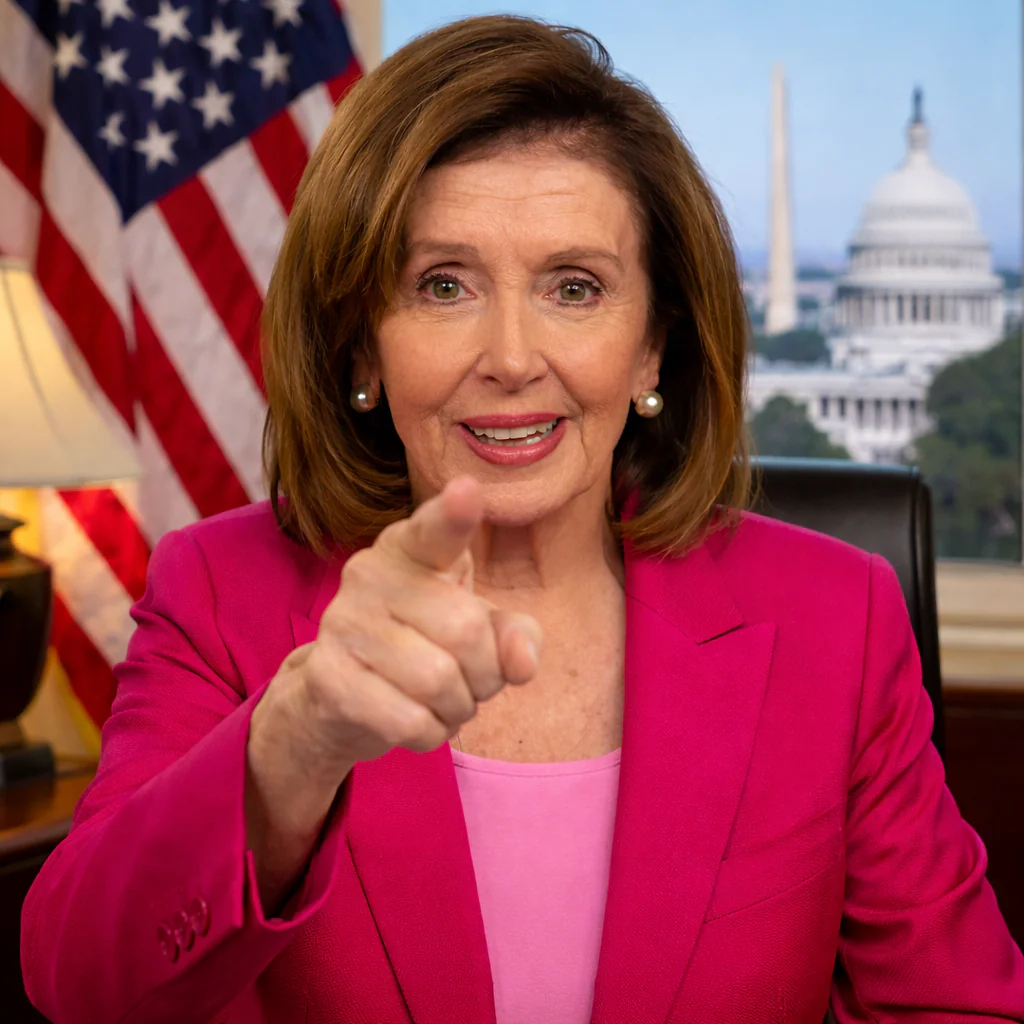
When Nancy Pelosi speaks about politics, she rarely limits herself to party talking points. In a recent appearance on The Weekend on MSNOW, the former House Speaker delivered a sweeping argument that blended history, economics, and a warning about the state of American democracy. At the center of her remarks was a bold claim: she believes former President Donald Trump has lost public sentiment — and without public sentiment, no political movement can endure.

Pelosi reached back to Abraham Lincoln to frame her case. Quoting his famous observation that “public sentiment is everything,” she underscored what she sees as the ultimate force in American politics. According to Lincoln, with public support, almost anything is possible; without it, almost nothing can succeed. Pelosi used that historical lens to argue that the true battleground today is not just Congress or the courts, but the minds and awareness of the American people.
In her view, public opinion has shifted as more voters learn about actions she characterizes as damaging to democratic norms. She suggested that transparency — the steady release of information, investigations, and public debate — has shaped how Americans interpret recent political events. As awareness grows, she argued, so does scrutiny. And as scrutiny grows, public sentiment evolves.
Pelosi framed the moment as one of heightened political consciousness. She contended that the more Americans understand what she describes as efforts that strain democratic guardrails, the more likely they are to react at the ballot box. For her, this is not merely a partisan critique but a larger reflection on how democracy functions. Institutions alone do not protect democratic values; informed citizens do.
Yet Pelosi was careful not to position the conversation solely around political confrontation. Instead, she pivoted to what she repeatedly called “saving democracy at the kitchen table.” That phrase, she explained, captures her belief that democracy is reinforced not only by constitutional principles but by economic security. For many families, the health of democracy is inseparable from whether they can afford groceries, pay rent, access healthcare, and secure opportunities for their children.
In that sense, Pelosi’s argument broadened beyond Trump or electoral politics. She outlined what she believes are the issues that truly resonate with working Americans: the rising cost of living, affordability pressures, job creation, education quality, healthcare expenses, and housing costs. She described housing not just as an economic matter, but as a public health issue — arguing that stable, affordable housing underpins family well-being and community stability.
For Pelosi, these bread-and-butter concerns are not distractions from democratic preservation; they are central to it. A democracy thrives, she implied, when families feel secure and empowered. If citizens are overwhelmed by economic hardship, their trust in institutions can erode. Thus, policy aimed at improving everyday life becomes part of the broader democratic mission.
She also touched on what she described as a persistent communication challenge. While lawmakers may pass sweeping legislation designed to boost domestic manufacturing, invest in infrastructure, or strengthen supply chains, those achievements do not always register with voters. Pelosi argued that “re-industrializing” parts of the country and revitalizing American manufacturing are significant accomplishments — but accomplishments only matter politically if people know about them.
That disconnect between policy success and public perception, she suggested, can shape election outcomes. Voters, she noted, rarely cast ballots based on distant past achievements. Elections are often driven by immediate concerns and future expectations. If families do not feel the impact of legislation — or if they are unaware of it — political credit can evaporate quickly.
Pelosi’s remarks reveal a layered political strategy. On one level, she is arguing that Trump’s influence is weakening as public understanding grows. On another, she is emphasizing that Democrats must communicate more effectively about economic achievements and policy wins. And on a broader level, she is making the case that democracy itself is sustained by both civic awareness and economic stability.
The interview highlighted how intertwined these elements have become. Public sentiment shapes elections. Elections shape policy. Policy shapes economic reality. And economic reality, in turn, influences public sentiment. It is a cycle that Lincoln understood — and one Pelosi believes remains as relevant today as it was in the 19th century.
Her tone was firm but strategic. Rather than focusing exclusively on criticism, she repeatedly returned to the idea of engagement. Democracy, in her telling, is not self-sustaining. It requires participation, awareness, and a connection between governance and daily life. Protecting institutions is essential, she implied, but so is making sure families see tangible improvements in their own circumstances.
Ultimately, Pelosi’s message was less about a single political rival and more about the enduring mechanics of American democracy. Public sentiment, she reminded viewers, is not static. It shifts as people learn, as they experience economic change, and as they weigh competing narratives about the country’s direction.
Her remarks reflect a broader conversation unfolding across the political landscape: how to balance institutional safeguards with kitchen-table concerns, how to communicate policy impact in a fragmented media environment, and how to ensure that democratic ideals resonate beyond Washington.
Whether one agrees with her assessment or not, Pelosi’s central argument is clear. Democracy is preserved not only through vigilance against perceived threats, but through policies that strengthen families and communities. And in the end, she believes, it is public awareness — informed, engaged, and economically grounded — that will determine the nation’s political future.
From Lincoln’s century-old wisdom to today’s polarized climate, Pelosi’s appearance underscored a timeless truth: in American politics, everything ultimately comes back to the people.