
Sofia Minotti was surprised to receive a letter last October from her local elections office, saying she would be dropped from the voting rolls in 30 days unless she provided proof of her US citizenship.
Minotti, who was born in Argentina and moved to the United States with her parents as a toddler, has been a US citizen for years. She said she quickly sent a scan of her US passport to the Denton County Elections Office, preserving her right to vote in next month’s Texas primary elections. Denton County, north of Dallas, confirmed she had shown proof of citizenship.
“I felt offended,” the 24-year-old graduate student said of the scrutiny. “I’ve voted in every election since I was 18, and now my vote was coming under question.”
Minotti is among dozens of US citizens in Texas alone to have been ensnared in a massive drive by the Trump administration to search for immigrants and other ineligible voters on state voter rolls.
The impact goes well beyond one state. Texas is among 27 states using a federal database overhauled last year to try to verify voters’ citizenship — and has flagged potential problems on just 0.0003% of queries nationwide. One Republican election official in another state told CNN that “the vast majority” of voters in their state flagged by the system turned out to be citizens after further investigation.
“The federal databases are not up to date,” said the person who asked not to be identified for fear of drawing the ire of the Trump administration and other Republicans. “They are not accurate. The last thing we want to do is disenfranchise eligible voters.”
As President Donald Trump has vowed to nationalize elections, his administration has already launched several efforts to insert itself into functions traditionally left to the states. That’s sparked worries about whether the exercise of flagging noncitizen voters will ultimately provide the administration a tool with which to challenge midterm results.

Trump has long baselessly claimed that improper voting by immigrants has affected election outcomes, notably the presidential contest he lost in 2020.
“It’s an attempt to exert pressure and control that is completely inappropriate and to lay the groundwork to be able to call into question the results if they don’t go the way that the administration wants them to go,” said Eileen O’Connor, a former voting rights attorney in the Justice Department who is now a senior counsel with the left-leaning Brennan Center for Justice.
White House spokesperson Abigail Jackson argued in a statement that federal laws give the Justice Department “full authority” to ensure that states maintain accurate voter rolls.
“President Trump is committed to ensuring that Americans have full confidence in the administration of elections, and that includes totally accurate and up-to-date voter rolls free of errors and unlawfully registered non-citizen voters,” she said.
States already audit their voter rolls. Here’s what’s changed
CNN spoke with state and local election officials to examine how voter rolls are being checked against a tool known as Systematic Alien Verification for Entitlements, or SAVE.
Federal law requires states to make “reasonable” efforts to ensure that ineligible individuals are removed from the rolls. States already use an array of tools to maintain voter registration lists on a rolling basis, including obtaining data on people who have moved from the US Postal Service and motor-vehicle agencies and reports on people who died from state and federal sources.
Trump administration officials are increasingly arguing that state lists covering more than 200 million registered voters should be error-free to preserve election integrity. “Even one person voting who shouldn’t have voted is one too many,” Assistant Attorney General Harmeet Dhillon said in a recent video.
SAVE has long been used to verify the citizenship and immigration status of people seeking government benefits. For years, some election officials also had agreements with the federal government to use the tool, for a fee, to check the citizenship status of voters. Some Republican officials and conservative activists called for expanded access to federal data to help vet voters.
The Trump administration dramatically expanded SAVE last year, linking it to Social Security and US passport data and allowing states to make bulk uploads of voter records for free. The administration has strongly encouraged states to use it.
In a letter posted online last year by Tennessee Secretary of State Tre Hargett, Trump praised Hargett for participating in SAVE, saying it demonstrates the Republican’s “commitment to safeguarding American elections.”

Officials in Democratic-led states have largely refused to participate in Trump’s voter-verification program, arguing that SAVE is unreliable and could lead to faulty matches that put legitimate voters at risk of being unable to cast a ballot.
States have made nearly 59 million voter verification queries since April, according to agency data provided to CNN. SAVE has flagged more than 18,000 suspected noncitizens among them.
US Citizenship and Immigration Services spokesperson Matthew Tragesser said in a statement that the agency “is just getting started with SAVE enhancements and is committed to strengthening the program and expanding its reach.”
“We encourage all states to utilize SAVE to help eliminate voter fraud and restore trust in American elections,” he added.
Some Republican election chiefs say SAVE is another useful way to check their state voter rolls — provided that officials carefully vet the results.
Using SAVE as part of its research, Idaho turned up about 760 potential noncitizens among the nearly 1.1 million people on the state’s voter rolls, Phil McGrane, Idaho’s secretary of state, told CNN last year. Most of the people flagged were indeed US citizens, said McGrane, a Republican. Eventually, election officials winnowed the list to about a dozen cases that were sent to Idaho State Police for possible criminal investigation.
McGrane said enhanced citizenship verification is worthwhile to ensure “that there’s public trust in elections and confidence in the process.”
“The fact that we’re taking action (and) showing that the numbers are minimal, I think that’s really important for the voting public,” he said.
How Texas has used SAVE
Texas was among the first states to use the revamped SAVE tool, running its entire list of more than 18 million registered voters through it last year. Secretary of State Jane Nelson, an appointee of Republican Gov. Greg Abbott, said the analysis found 2,724 suspected noncitizens and referred them to individual counties to investigate further.
The state directed counties to give voters 30 days to verify their citizenship. But election officials across Texas have identified citizens flagged in error.
“It’s pretty clear that the list isn’t as close to accurate as the federal government thinks,” said Chris McGinn, the executive director of the Texas Association of County Election Officials.
A spokesperson for Nelson’s office did not respond to CNN’s questions.
In Denton County, where Minotti votes, the state identified 84 potential noncitizens on the county rolls. Frank Phillips, the county’s election administrator, said his review found that 14 had indicated they were not citizens on voter registration forms but had been improperly added to the registration rolls. None had a history of voting in the county. They have been removed from the rolls.
Fifteen, including Minotti, have provided documents establishing their citizenship and remain on the rolls.
But the majority of those flagged as suspected noncitizens — 55 — have not responded to the county’s notices and have had their registrations canceled, according to the county’s tally. Some could be US citizens and might show up to vote in upcoming elections without realizing they had been removed from the rolls.
“My fear is that they got the letter during a time period when there was a lot of campaign mail going out, so never looked at it or just threw it away and now they have been removed,” Phillips said.
Emily French, policy director at the voter advocacy group Common Cause Texas, said the process so far appears to mostly affect foreign-born people who later gained US citizenship.
“The No. 1 victim of this is always newly naturalized citizens because they have years and years of data saying they are not citizens and then they become one and cast their first vote,” she said.
French notes that, under Texas law, voters incorrectly removed can be restored to the voting rolls as soon as they provide proof of citizenship. She suggests voters check their registration status with their election office if concerned they were improperly removed.
What the voter rolls push could mean for the midterms
US Citizenship and Immigration Services has cautioned states to “take additional steps” to verify voters’ status and to provide due process before removing them from the rolls. Trump administration critics argue the approach used widely in Texas — sending out notices giving voters 30 days to prove their citizenship — puts the burden on voters to prove they have done nothing wrong and find paperwork to show to the government.
“The upshot here is that they have imposed a backdoor documentary proof-of-citizenship requirement, which is something that folks in the Trump administration have been trying to pursue through other avenues,” said Nikhel Sus, chief counsel of Citizens for Responsibility and Ethics in Washington, pointing to unsuccessful efforts in Congress to pass that requirement.
CREW represents voting rights and privacy advocates who are suing in federal court to block the administration’s continued use of SAVE. The lawsuit contends that, among other issues, SAVE is unreliable for voter verification because the Social Security Administration does not automatically update the citizenship status of people who become naturalized after they obtain Social Security numbers.
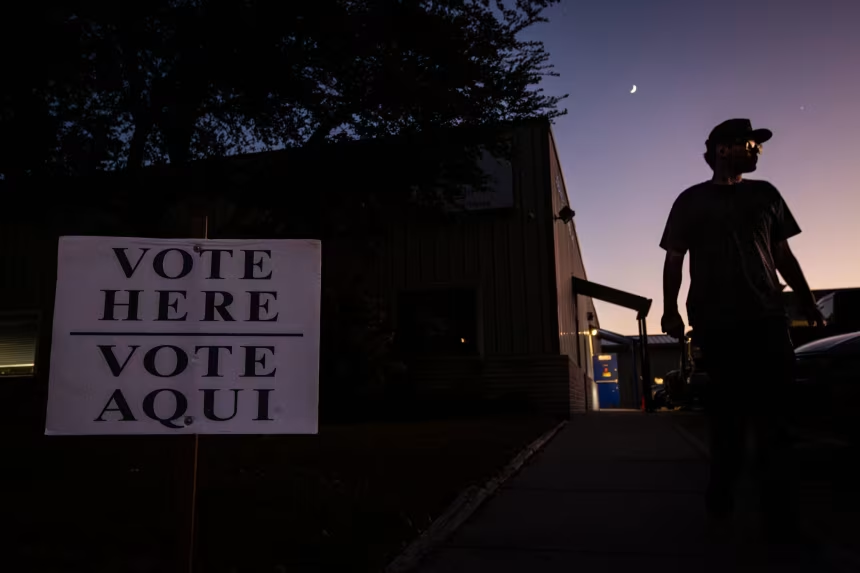
Early voting in Texas starts on February 17 ahead of March 3 primaries, which include closely watched races for US Senate and several potentially competitive House races.
Minotti, who is working on her master’s degree in counseling, said she nearly missed the Denton County notice because she doesn’t pay much attention to mail and, at first, ignored the plain white envelope from the election office.
Minotti said she’s now paying close attention to everything election related. “Voting is just one of the ways we can express our opinion,” she said.
In the meantime, she said, the dates for the upcoming elections are circled on her calendar.